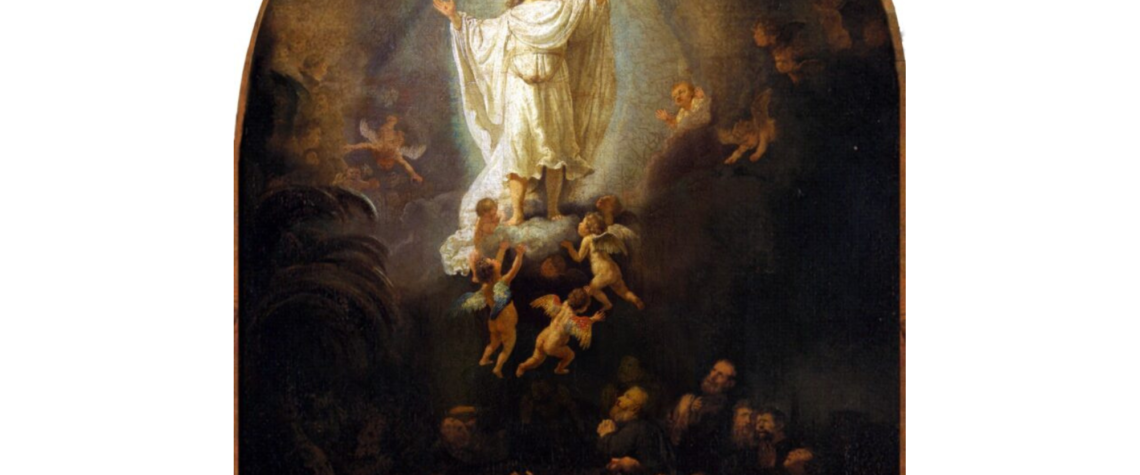
There is a moment in the Ascension narrative that can startle our heart if we let it. Jesus rises, the cloud receives Him, and the apostles stand there, frozen, staring upward, their eyes fixed on the last place they saw Him. Then two angels appear and ask a question that slices through the silence: “Men of Galilee, why do you stand looking up toward heaven?”
It is a question that exposes something deep in the human soul. We long for certainty. We long for visible proof. We long for God to act in ways we can see, measure, and confirm. The apostles were no different. Just moments earlier they had asked Jesus, “Lord, is this the time when you will restore the kingdom to Israel?” They were ready for the finale, the fulfillment, the restoration. But Jesus redirects them: “It is not for you to know the times or periods…”
In other words: the promise is certain, but the schedule is not ours. We have to live each day like Jesus will return tomorrow, because He might.
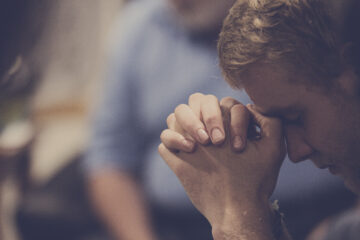
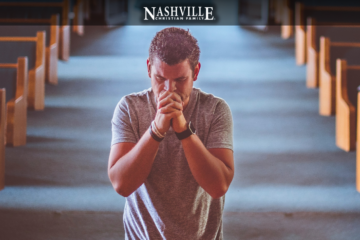
And this is where the apostles show us the way. They do not return to Jerusalem discouraged. They do not interpret “not yet” as “not ever.” Instead, they embrace what might be the most underrated virtue in the Christian life: disciplined hope. They gather with Mary and the early believers. They devote themselves to prayer. They wait, not passively, but purposefully. Their anticipation becomes preparation.
The Church Fathers describe them as praising God continually in the Temple, living in a posture of expectation for what would come “from on high.” Thomas Aquinas later explains that Christ’s withdrawal is not a loss but a gift, because faith grows stronger when it leans on what is unseen, hope stretches higher when it waits for what is promised, and charity deepens when it reaches toward heaven without needing to see heaven.
Augustine adds the inner logic: faith and hope cling to realities not yet visible, and hope requires patience, the willingness to trust God’s timing without demanding God’s timetable.
The apostles teach us how to live in the holy tension between promise and fulfillment. They waited in prayer. They sought the Spirit. They prepared their hearts. And when the Spirit came, they did not hesitate, they became witnesses to the ends of the earth.
The angels’ question still echoes today: “Why are you still looking up?”
Not to shame us, but to awaken us. When we do not know when, God invites us to focus on how:
How to pray.
How to hope.
How to witness.
How to live today with the fire of the Kingdom already burning within us.
Jesus’ Ascension is not an ending or a pause in God’s work. It is the beginning of ours. May we stop staring upward in uncertainty and start stepping forward in mission.
If this is my last post, I want all to know there was only one purpose for all that I have written; to have made a positive difference in the lives of others.
—Anthony “Tony” Boquet, the author of “The Bloodline of Wisdom, The Awakening of a Modern Solutionary” and “The Passion, Death, and Resurrection of Jesus Christ, A Devotional Timeline”