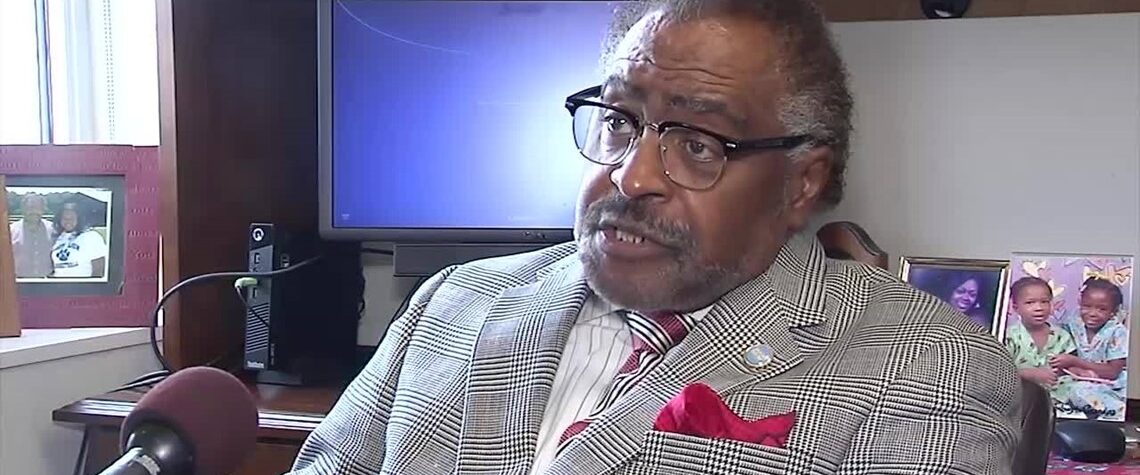
John DeBerry proudly calls himself a bridge builder.
A former member of the Tennessee House of Representatives and the current Senior Adviser to and member of Governor Bill Lee’s cabinet, John DeBerry has a strong conviction to use his Christian faith and heart for public service to do what’s right for his constituents. Because of that, he wants to be a bridge builder who serves everyone despite political parties, religious faith, or anything else that might divide the people of Nashville and Tennesseans in general.
“What I see now is that we too often maximize our differences and minimize the similarities. There are people who love to create division and chaos,” DeBerry said. “But if I have a seat at the table, I have a responsibility to build consensus and listen to everyone from across the state.”
A Faith Background
DeBerry was raised in a Christian home and was surrounded by Christian pastors and leaders. His father preached for more than 60 years and today DeBerry himself is pastor at Coleman Avenue Church of Christ in Memphis
DeBerry felt the call to ministry when he was young and has been in the pulpit since he was 17 years old.
“I dreamed about being a preacher from an early age, and I studied under my dad’s feet,” he said. “Today I always go home every week and preach.”
DeBerry’s father, grandfather, and great grandfather preached; both of his brothers are preachers, one brother-in-law is a preacher, and a son is a deacon as are nephews.
While his professional background is in business and marketing (and now he works in politics), DeBerry has worked as a bi-vocational pastor for his entire adult life. It’s an example he saw from his father–and one that still inspires him as he works in both ministry and public service.
“I’ve always been a working preacher, and my dad was that way too,” he explained. “He was a veteran who worked at the post office and also preached. My background is in radio and television and I established a marketing firm in the 1990s that’s still operating.”
According to DeBerry, that multifaceted life and career makes him more effective in all corners of his life.
“It keeps me grounded and makes me a better minister,” he said. “Straying involved in politics, public policy, and business keeps me better connected to people. Everyone has a lot going on and I can understand their lives better because I see it from different viewpoints.”
A word he uses often in describing his ministerial and political work is “blessed.”
“Faith is the foundation of everything, and I’m very blessed,” he said. “It all goes back to my great grandparents, grandparents, and parents. They led the way for me and my family.”
DeBerry said that his faith and worth are inseparable. He truly can’t do one without the other.
“If you don’t have a Christian or spiritual basis…if you don’t believe in something bigger than yourself and trust a wisdom greater than your own, then I don’t see how you can be an effective public servant,” DeBerry said, noting that the constitution of Tennessee recognizes God and faith. “The word of God,” he said “is the basis for it.”
In his past political work as a state representative, as well as his current work on the governor’s cabinet, DeBerry said that he recognizes that his constituents are primarily Bible-believing people who have conservative and moderate values. They’ve always understood his values and he’s fought for them even when he’s felt pushback for it.
That, he said, is key in political power–to recognize what those whom you serve expect from you and to respect their needs and wants from their representatives. As a Christian serving other Christians, his faith is key in that work.
Political Work in Tennessee
DeBerry was first elected in 1995 and went on to serve for 26 years as a member of the state house of representatives as a Democratic lawmaker. During his career, he chaired committees on children and family and served on health and finance committees.
After coming out in favor of the state’s “heartbeat bill” and against abortion, DeBerry was decertified by Democratic leadership and invited by Lee to serve in his cabinet.
DeBerry said he has no animosity about his decertification, instead insisting that his constituents understood his conservative beliefs on certain issues and looking to the positives from the move.
“The people who elected me knew I believed in a creator, in life, and in parental responsibilities and authority,” he said. “I campaigned on these issues, so it wasn’t my district that disagreed with me. They understood my heart and where I stood.”
When Lee invited him to serve on his staff, DeBerry saw it as an opportunity to bring people together.
“He offered me this position in his cabinet specifically to utilize my experience with members of the house of representatives and my ability to build bridges across the aisle,” he said. “My goal always is to get public input and work for what’s best for our people.”
DeBerry said he recognized the governor as a fellow Christian and family man who had similar experiences as himself. They both had lost wives and raised children for years on their own.
He prayed about the job invitation from Lee and decided to take the step and accept the position. It’s one that has vastly enriched his life and faith–especially as he meets the people of Tennessee and learns about their lives and struggles.
DeBerry is the first African American in the history of the state to have an office on the first floor of the state building, and he treasures the opportunity to meet with and serve the other diverse members of the state and local communities.
“The governor uses me as an ambassador, and I talk with different group, different ethic groups, people from different background, even different political groups and individuals,” he said. “I’ve been very blessed to work with Native Americans, African Americans, African, Latinos, and others. It’s a privilege to sit in this office, represent the governor, and serve all of our people.”
Love of Family
DeBerry’s pride in and love for his family is evident, and it guides both his ministerial and political work.
He met his wife in college at Freed-Hardeman University in 1972 and were married for almost 45 years. He lost her in 2015 after she suffered a stroke. He and his wife had two daughters, Chevida (who is an attorney and married to a doctor in Memphis) and Victoria (who also lives in the Memphis area). His extended family includes two brothers and numerous nieces and nephews.
“My daughters are wonderful children and I have very good grandkids. I’m very proud of them,” DeBerry said. “My daughters both look like my wife, and I see her strength in them.”
DeBerry was raised in a strong Christian family and had what he considered three sets of parents–his parents, grandparents, and great grandparents–who lived in houses side by side.
“I had three different generations who were strong, resilient, and took no excuses even in the days of segregation,” he said.
His dad worked with Martin Luther King Jr and was with him at Pettus Bridge and at his last speech in Memphis. His mother campaigned against abortion, and both parents instilled in DeBerry the passion for public service and standing up for the underserved without a need for recognition.
“My Dad was one of the many unnamed faces in the crowd during the civil rights movement, and he was there for the work, not the recognition,” he said. “He taught me that it’s not about myself, it’s about the job. It’s about making the world better.”
Before his father died, he reminded DeBerry that they shared a name (“He told me all the time, ‘Don’t mess up my name’”) and he reminded him that there was a better place waiting for Christians.
“I kept those words close to my heart,” he said.
A Call to Unity
DeBerry’s message to Tennesseans is that “we are more similar than we are different.”
In his work at the governor’s office in Nashville, and from his pulpit in Memphis, DeBerry stresses that working together is key to a better future.
He bemoans the fact that people on different sides of the political and religious spectrums are unable to be friendly with one another. In the past, he said, people could disagree and still be friends.
“Sometimes you won, sometimes you lost, but it wasn’t personal. Now things are so personal, divisive, and toxic,” he said. “When we lose sight of what God wants us to be, that’s when we create division.”
Author, Freelance Writer, Speaker – This is my story.